
Klaviyo Review 2026: Is It Worth It?
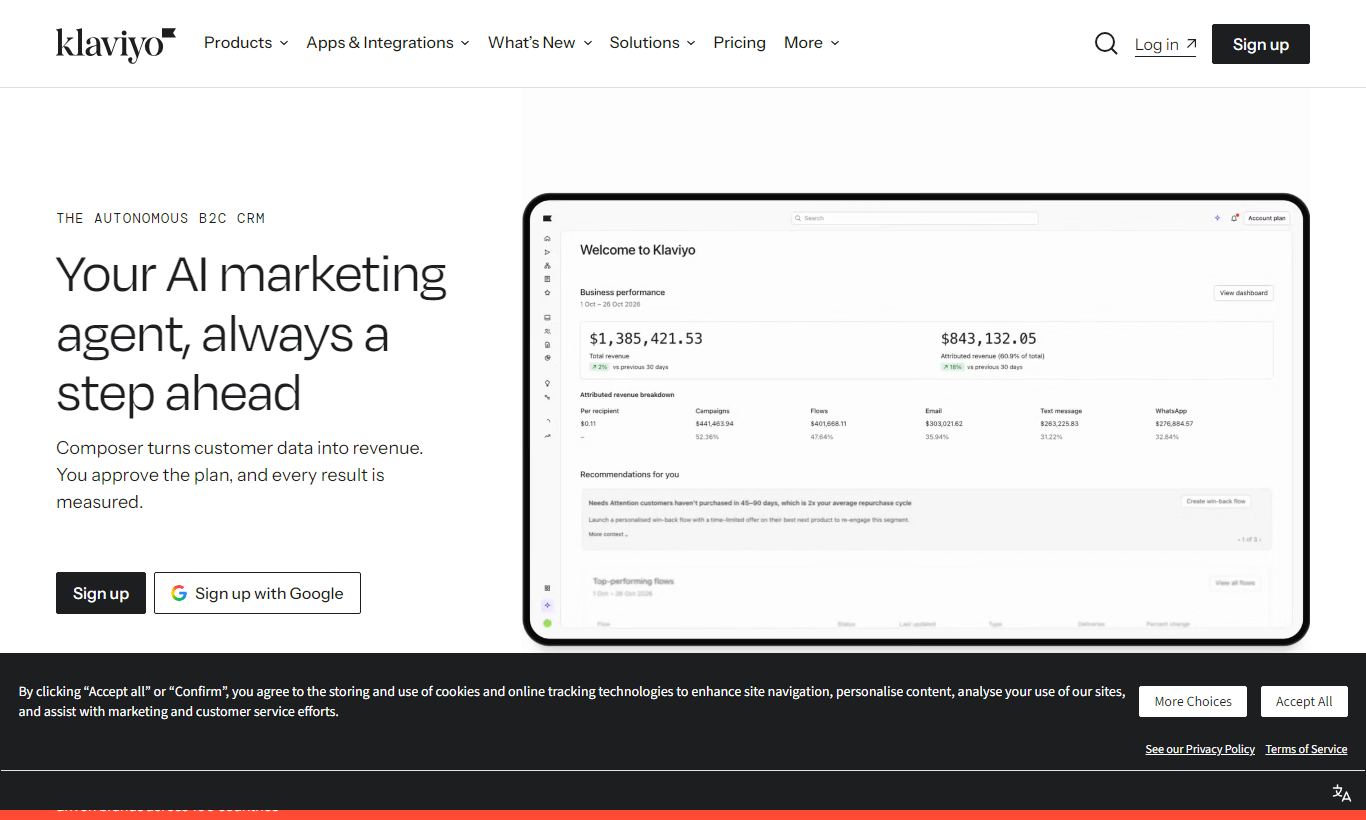
Klaviyo is a marketing automation platform built specifically for e-commerce brands. It combines email, SMS, and push notifications with deep data segmentation, pulling order history, browse behaviour, and predictive analytics directly from your store to power tightly targeted campaigns. Plans start free for up to 250 contacts (500 email sends a month), with paid tiers scaling from $20/month. Klaviyo's standout strength is its native integration with Shopify, WooCommerce, and BigCommerce. That makes it far easier to build revenue-attributed flows than general-purpose tools like Mailchimp. The tradeoff: pricing climbs steeply at scale, and the interface has a learning curve for non-technical marketers. For e-commerce brands doing $500K+ in annual revenue who want genuinely data-driven automation, Klaviyo is one of the most capable platforms on the market.
What we love
Watch out for
Klaviyo at a glance
What to test in your Klaviyo trial
Free plan
- Connect your Shopify store and verify that orders, product catalogue, and customer tags sync in real time
- Build one abandoned cart flow using product recommendations and test it with a test purchase
- Create a segment using predictive analytics (churn risk or lifetime value) and check that it updates as orders come in
- Set up an email and SMS flow on the same canvas with conditional logic based on customer behavior
- Test dynamic product recommendation blocks in an email campaign with your actual browse and purchase data
Quick Verdict
Klaviyo earns its reputation as the go-to email and SMS marketing platform for e-commerce, and it does so through genuinely deep data infrastructure rather than marketing hype. Most marketing tools treat your customer list as a flat spreadsheet. Klaviyo treats it as a living dataset: every product viewed, cart abandoned, order placed, and coupon redeemed feeds directly into its segmentation and automation engine. For Shopify merchants in particular, the integration is nearly frictionless, turning your store's behavioral data into triggered flows within minutes of setup.
Klaviyo isn't for everyone, though. Its pricing becomes a real consideration once your list grows past 10,000 to 20,000 contacts, and marketers used to simpler drag-and-drop tools will hit a steeper learning curve than they might expect. If you're an e-commerce brand with a growing customer base and a genuine need for sophisticated segmentation, predictive analytics, and multi-channel automation, Klaviyo is hard to beat. If you run a SaaS company, a services business, or a content site, there are better-suited tools at lower cost.
Start Your Free Trial →What is Klaviyo?
Klaviyo was founded in 2012 by Andrew Bialecki and Ed Hallen in Boston. Their thesis was simple: e-commerce brands needed a marketing platform that treated purchase data as central, not bolted on as an afterthought. The company grew steadily through the Shopify ecosystem and went public on the NYSE in September 2023. Today it serves more than 130,000 paying customers globally, most of them direct-to-consumer (DTC) brands across fashion, beauty, food and beverage, home goods, and consumer electronics.
Klaviyo's core offering spans email marketing, SMS/MMS, mobile push notifications, and a customer data platform (CDP) that unifies event and profile data across channels. It's built for online retailers, and its pricing model, feature set, and integration catalogue all reflect that focus. It competes directly with tools like Mailchimp, Omnisend, and Attentive, and positions itself as a single platform that replaces the need for a separate ESP, SMS provider, and analytics tool.
Key Features
Feature Checklist
Flows (Automated Email & SMS Sequences)
Klaviyo's "Flows" are its automation backbone. These are trigger-based sequences that fire based on customer actions like abandoned checkout, product browsing, post-purchase timing, or custom events you define via API. The flow builder is a visual canvas where you drag in triggers, conditional splits, time delays, and message blocks. A typical abandoned cart flow for a Shopify store can be live in under 30 minutes, pulling in real product images, prices, and a direct checkout link automatically. The conditional split logic is notably powerful. You can branch based on whether a customer has made more than two previous purchases, what their predicted lifetime value tier is, or whether they opened the last email. This is where Klaviyo separates itself from simpler tools.
Segmentation & Customer Data Platform
Klaviyo's segmentation engine is genuinely best-in-class for e-commerce. You can build audiences using any combination of event data (placed order, viewed product, clicked link), profile properties (location, acquisition source, Shopify tags), and predictive analytics (expected date of next purchase, churn risk, lifetime value tier). Segments update in real time, so a customer who just placed their first order gets moved out of the "never purchased" segment and into the "first-time buyer" flow with no manual action needed. For a brand selling across multiple product lines, this makes genuinely granular targeting possible. You could build a segment of customers who bought skincare but never bought haircare, with predicted lifetime value above $200, in a couple of clicks.
Email Campaign Builder
The drag-and-drop email editor has improved significantly over the past two years. It now supports a library of pre-built blocks (product feeds that pull live inventory, countdown timers, dynamic coupon codes), plus a growing template library built for common e-commerce scenarios: sale announcements, loyalty milestones, review requests. The AI-assisted subject line tool generates and A/B-tests variants automatically. One standout feature is dynamic product recommendations. Klaviyo can populate email sections with "recommended for you" product blocks driven by browse and purchase history, with no third-party integration required.
SMS & MMS Marketing
Klaviyo's SMS product covers the US, Canada, UK, and Australia, supporting both one-time campaigns and triggered flows. MMS allows image and GIF attachments, which works particularly well for flash sales and product launches. SMS and email sit in the same flow canvas, so you can build a true multi-channel sequence: email at hour 1, SMS at hour 4 if no email open, push notification at hour 24. Compliance tooling for SMS (opt-in keyword management, quiet hours enforcement, carrier-compliant messaging) is handled automatically, which saves real operational overhead compared to running a standalone SMS platform.
Predictive Analytics & Reporting
Klaviyo calculates predicted lifetime value, churn risk, expected next order date, and gender probability directly from your store's order history. You don't need a data science team for any of it. These predictions feed straight into segmentation, so you can build flows aimed specifically at high-LTV customers at risk of churning, or suppress low-LTV contacts from paid ad audiences through the Facebook and Google integrations. Reporting runs deep at the campaign, flow, and individual message level, with revenue attribution available on either last-click or multi-touch models. Benchmark reporting, which compares your open rates, revenue per recipient, and list growth against anonymised peers in your industry, is available on paid plans and is genuinely useful for calibrating expectations.
Pricing
Klaviyo's pricing is contact-based and scales with your email list size. Email and SMS are billed separately.
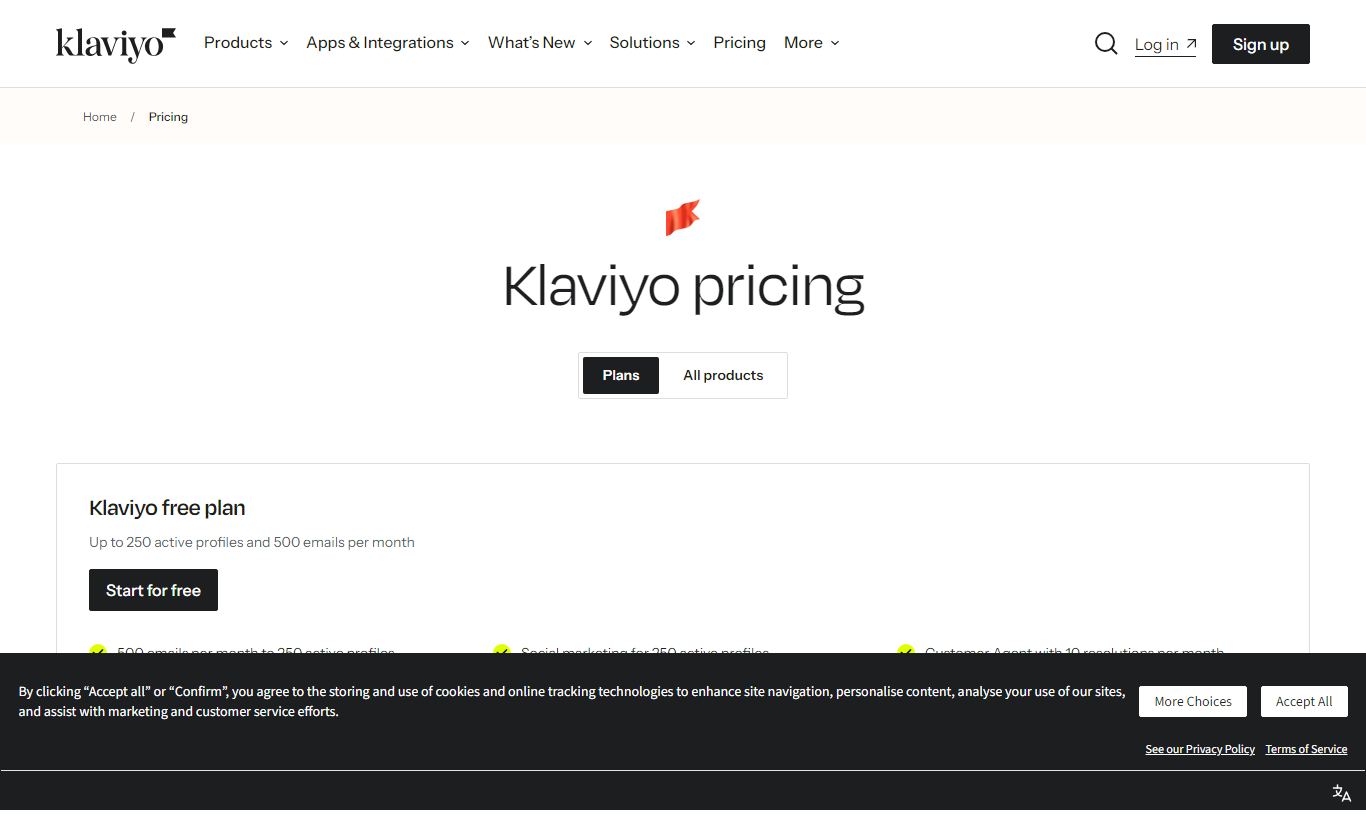
Free Plan: Up to 250 email contacts, 500 email sends per month, 150 free SMS/MMS credits. You get full access to flows, segmentation, and integrations. It's a genuinely useful free tier for brands just starting out, not a crippled trial.
Email Plan: Starts at $20/month for up to 500 contacts, and scales from there: $30/month for 1,000 contacts, $100/month for 5,000 contacts, $150/month for 10,000 contacts, $400/month for 30,000 contacts, $700/month for 60,000 contacts. All paid email tiers include unlimited email sends, email support, and full feature access, including predictive analytics and A/B testing.
Email + SMS Plan: Starts at $35/month for 500 contacts, combining email sends with an SMS credit bundle. If you exceed the bundle, you buy SMS credits separately as add-ons. US SMS runs about $0.01 per message sent and $0.01 per message received.
Klaviyo doesn't list a separate "Enterprise" tier publicly. Large brands typically negotiate custom contracts that may include dedicated deliverability support and a customer success manager. Annual billing offers a modest discount, typically around 5 to 10%. There's no free trial beyond the free plan itself. You just upgrade when you exceed the contact or send limits.
What We Love
- Native Shopify integration that goes beyond order data. Klaviyo syncs Shopify discount codes, customer tags, metafields, and product catalogue in real time. That lets you personalise in ways that would need custom dev work on competing platforms.
- Real-time segmentation with predictive LTV and churn scoring. Segments update instantly as customer behaviour changes. Predictive metrics mean you can act on likely future behaviour, not just past actions.
- Unified email + SMS flows on a single canvas. Managing multi-channel sequences in one builder cuts operational complexity and makes cross-channel attribution genuinely accurate.
- Generous free plan with full feature access. Mailchimp's free tier restricts automation features. Klaviyo's free plan includes flows, segmentation, and all core integrations, which is genuinely useful for early-stage brands.
- 350+ pre-built integrations including Shopify, WooCommerce, BigCommerce, Recharge, and Yotpo. The depth of integration with e-commerce-adjacent tools (subscriptions, loyalty, reviews) means customer data stays unusually complete without custom API work.
Watch Out For
- Pricing scales aggressively beyond 10,000 contacts. At 50,000 contacts, email-only pricing reaches approximately $600/month. For high-volume senders with large but low-engagement lists, this becomes a real budget line. Regular list hygiene is a must if you want to keep costs in check.
- The interface has a genuine learning curve for non-technical marketers. The flow builder's power comes with complexity. New users often report confusion around trigger filters, flow filters, and the difference between segment-based and event-based triggers. These concepts take real onboarding time to get right.
- SMS is only available in four countries (US, CA, UK, AU). For brands with meaningful customer bases in Europe, Asia, or Latin America, Klaviyo's SMS offering won't work as a standalone solution, so you'll need a supplementary provider.
- Customer support is email/chat only on most plans. Phone support isn't available, and response times on the lower paid tiers during peak periods (BFCM season) have drawn steady complaints in user reviews on G2 and Trustpilot.
Who Is It Best For?
The scaling DTC brand on Shopify ($500K - $10M revenue): This is Klaviyo's home turf. A brand in this range usually has enough order history to make predictive analytics mean something, enough SKU complexity to benefit from dynamic product recommendations, and enough list size to justify the per-contact cost. The Shopify integration cuts out months of technical work. Pre-built flow templates (welcome series, win-back, post-purchase, VIP) pay off almost immediately.
An in-house e-commerce marketer who owns both email and SMS: If one person or a small team runs both channels, the unified canvas beats managing separate tools by a wide margin. Building a single abandoned cart flow that branches into email and SMS, with shared reporting and attribution, is much faster than coordinating two platforms.
A Klaviyo Agency or Freelance Consultant: Klaviyo's partner programme, multi-account management interface, and client-facing reporting suit agencies running email programmes for multiple DTC clients. The platform's complexity also feeds a solid market for specialist consultants who charge for setup and optimisation.
How Does It Compare?
Klaviyo vs Mailchimp: Mailchimp costs less at small list sizes and is easier to learn, but its e-commerce data model is a lot shallower. Klaviyo's predictive analytics, real-time segmentation, and native Shopify sync make it more powerful for product-based businesses. Klaviyo vs Mailchimp
Klaviyo vs Omnisend: Omnisend is a close competitor specifically in the e-commerce email and SMS space. It offers a similar feature set and slightly lower pricing at mid-range list sizes. Klaviyo's data infrastructure and predictive analytics are more advanced. Omnisend is still a solid alternative for brands where budget is the main constraint. Klaviyo vs Omnisend
Final Verdict
Klaviyo has built the most data-rich marketing automation platform available specifically for e-commerce. For the right brand, that depth pays for itself many times over. The combination of real-time segmentation, predictive analytics, and unified email and SMS on a single canvas is hard to replicate with other tools. The free plan is one of the most capable entry points in the category. You can build a complete automated email programme before spending a dollar.
The limitations are real. Pricing at scale requires careful list management, SMS geography is limited, and new users will spend real time learning the platform properly. If you're a SaaS company, a B2B services firm, or a content creator, Klaviyo's e-commerce-first design won't fit well. But for any product-based business serious about turning customer data into revenue, it's still the one to beat.
Try Klaviyo Free →FAQ
Is Klaviyo free to use?
Yes. Klaviyo's free plan supports up to 250 email contacts, 500 email sends per month, and 150 SMS/MMS credits. The free plan includes full access to flows, segmentation, and integrations, not a stripped-down trial. You only need to upgrade once you exceed the contact or send limits.
How much does Klaviyo cost per month?
Klaviyo's email plan starts at $20/month for up to 500 contacts. Pricing scales with list size: about $100/month at 5,000 contacts, $150/month at 10,000, and $400/month at 30,000. Adding SMS starts the combined plan at $35/month for 500 contacts. There's no flat enterprise tier. Large brands negotiate custom pricing instead.
Is Klaviyo worth it for small businesses?
For small e-commerce businesses, yes. The free plan is genuinely functional, which makes the decision easy. A brand with fewer than 5,000 contacts on a $100/month plan gets predictive analytics, automated flows, and Shopify integration that would cost far more to replicate with competing tools. For non-e-commerce small businesses, the case is weaker.
How does Klaviyo compare to Mailchimp?
Mailchimp is cheaper and easier to learn at small list sizes. Klaviyo, though, offers deeper e-commerce data integration, real-time segmentation, and predictive lifetime value scoring that Mailchimp can't match. For Shopify-based brands, Klaviyo's native integration and revenue attribution are noticeably stronger.
Does Klaviyo work with Shopify?
Yes. The Shopify integration is Klaviyo's most mature and deepest connection to any platform. It syncs customer profiles, order history, product catalogue, discount codes, and Shopify customer tags in real time. Most Shopify merchants finish the setup and have their first automated flow running within a single session.
What are the main limitations of Klaviyo?
Three limitations come up most often. Pricing scales steeply past 10,000 to 20,000 contacts. SMS support is restricted to the US, Canada, UK, and Australia only. And the flow builder has a real learning curve that takes genuine onboarding time. Customer support is email and chat only, with no phone line, which frustrates users during high-traffic periods like Black Friday.
Can Klaviyo do SMS marketing?
Yes. Klaviyo supports SMS and MMS marketing in the US, Canada, UK, and Australia. You can build SMS flows on the same canvas as email flows, with shared triggering, conditional logic, and revenue attribution. SMS credits come included in the Email + SMS plan, or you can buy them as add-ons at roughly $0.01 per message sent.
We may earn a commission when you click affiliate links. This never affects our editorial scores.
| Best for | eCommerce email marketing |
| Category | Marketing Automation |
Answer a few quick questions and we'll match you to the best tool for your needs.
→ Suggest a Tool